Quantum arrows
(Eingestellt am 24. Oktober 2026, 21:04 Uhr von Monty)
Normal sudoku rules apply. Each red line is an arrow i.e., the digit in one of its circles must equal the sum of all the other digits along the line, including the digit in the opposite circle. You must determine which endpoint is the sum for each arrow. For example, both r1c8=3, r2c8=6, r1c9=9 and r1c8=9, r2c8=6, r1c9=3 are valid configurations. The two arrows crossing diagonally in r3c3 are separate arrows, and the digit in r3c3 contributes to both sums.
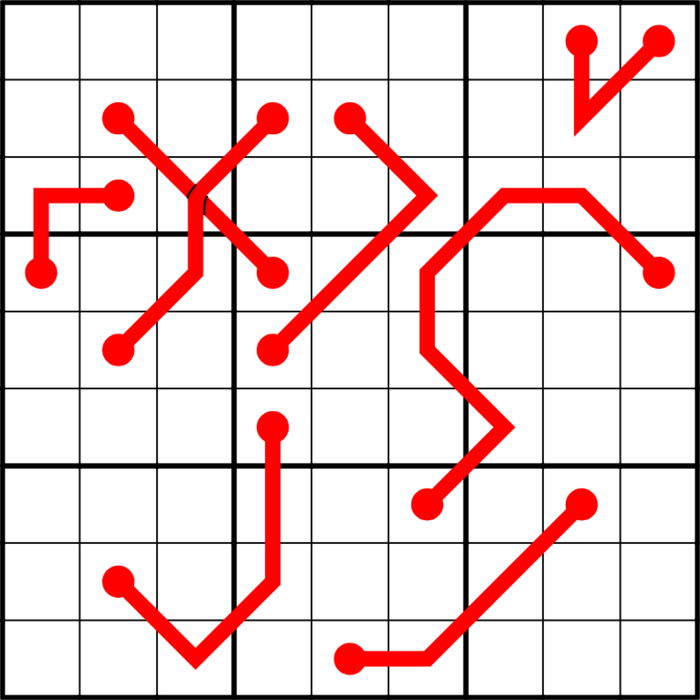
Good luck!!
Lösungscode: Provide the digits of the 5th row from left to right as a string of 9 numbers eg. 123456789
Gelöst von jalebc, sparticle999, SKORP17, sedici, AKernel, PippoForte
Kommentare
am 24. Oktober 2026, 23:13 Uhr von sparticle999
This is very well constructed. I like the initial elegant steps


