by Liam McGrane
Introduction
Somewhere in the Atlantic, 1868.
For a while now I have been a prisoner aboard the Nautilus. Yet I confess that captivity beneath the seas has not been without its pleasures. Though I still long for freedom, my scientific curiosity has often made the walls of my prison easy to forget.
Today, however, our circumstances have taken a far more alarming turn.
We find ourselves surrounded by enormous cephalopods – monstrous creatures whose great arms now swarm about the Nautilus. Through the glass I have watched them writhe around us, and I can no longer regard them merely as specimens worthy of study. They are an immediate and terrible danger.
I was stunned as to what we should do, and Captain Nemo replied that we would “go to the surface and slaughter all of these vermin.”
I said that seemed a difficult task, to which the Captain merely said: “Indeed.”
This sums the current state of affairs, and we begin our ascent to the surface, avoiding these despicable creatures along the way.
Excerpt from journal of Dr. Pierre Arronax
Rules
In addition to the text-only rules, full illustrated rules can be found below
Normal Sudoku Rules: Place the digits 1–9 in every row, column and 3×3 box without repeats.
Dynamic Fog-of-War: The grid is partially covered by fog. Placing enough correct digits will clear fog somewhere in the grid.
Cephalopods: The grid contains cephalopods made of thermos (digits strictly increase from the bulb), each with a distinct color, with the following anatomy:
eye – a single thermometer bulb, with a common digit E.
tentacles – one to three thermos (with a shared bulb), with a common digit T at their tips. Across all cephalopods, no two tentacles have the same length (length includes bulb), and none may intersect itself or another.
head – an additional thermo coming from the eye which, excluding the bulb, exclusively contains the lengths of all of its tentacles.
The Nautilus: Starting from the circle in the bottom row, draw a direct path to the top, taking exactly one cell per row. It must be a valid parity-line (alternating between odd and even) and may move orthogonally or diagonally. The circle contains digit E, and the digit T must appear somewhere on the Nautilus path. The Nautilus path may intersect cephalopods but may not occupy any of their cells (i.e. a diagonal crossing in a 2×2 is allowed).
Ascend to the surface adjacent to a creature’s eye to deal a fatal blow, OR miss and await your demise…
Rules feel longer than 20,000 leagues? Here are the rules with some visual examples.
Examples
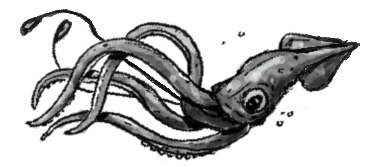
Cephalopods
The grid contains multiple cephalopods where each is a multi-tip thermometer.
What are thermometers?
A thermometer is a line of strictly increasing digits that begins at a bulb.
A multi-tip thermometer is two or more thermometers that share one bulb.
It is worth knowing that the length of a thermometer always includes the bulb.
Anatomy of a Cephalopod
A cephalopod is comprised of three features: an eye, a head and one to three tentacles.
Eye
The eye of the Cephalopod is the thermometer’s bulb.
Across all cephalopods, all eyes contain the same digit
E.
Tentacles
One to three thermometers (all starting from the eye). Across all cephalopods, every tentacle ends in the same digit
T.
Head
One more thermometer (also starting from the eye). The digits on this thermometer - excluding the eye - are exactly the lengths of each of that cephalopod’s tentacles.
Note: There is nothing visually distinct between the tips of heads and tentacles.
Quite Unique
Across all cephalopods…
…no two tentacles have the same length.
…no cephalopods have the same colour.
…and none may intersect in any way, either with themselves or other cephalopods.
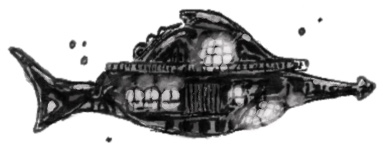
The Nautilus
Starting from the circle in row 9, draw a path to row 1.
The Path
The path may move diagonally or orthogonally but may only ever take one cell per row.
The path may intersect cephalopods but only in a 2x2 diagonal and such that the path never occupies the same cell as one.
The Digits
Digits along the path must alternate parity (alternate between odd and even).
Resemblance
As well as adhering to the parity rule…
…the digit E must appear in the circle in row 9.
…and digit T must appear somewhere on the path.
Ascend to the surface adjacent to a creature’s eye to deal a fatal blow, OR miss and await your demise…


