Determination
(Eingestellt am 26. Dezember 2025, 00:00 Uhr von NXTMaster)
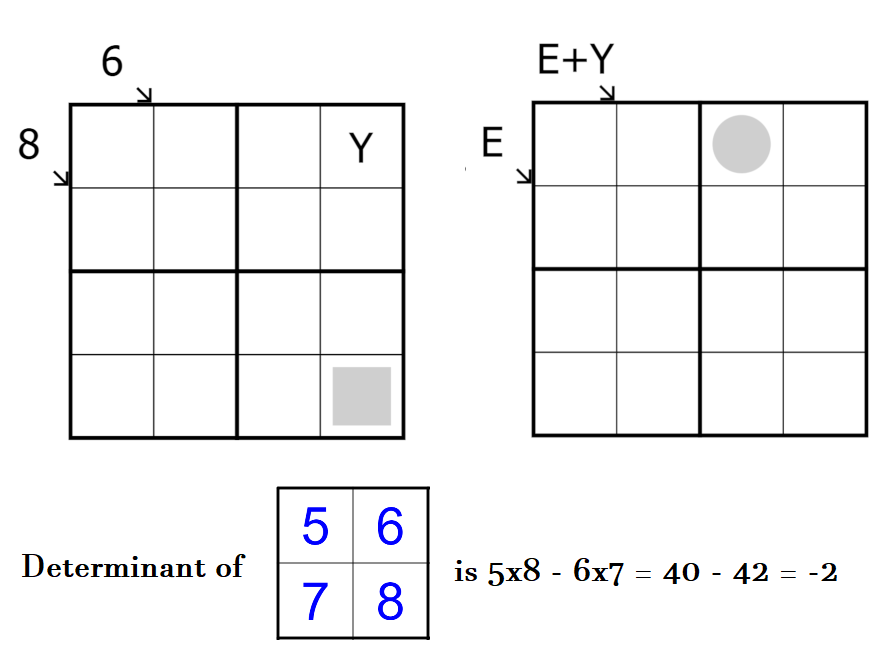
This puzzle is a self-imposed challenge from 2022 inspired by DiMono's Small Murders featured on the CTC YT channel for April Fool's. I wanted to make my own difficult 4x4, but this puzzle turned out to be rather insane. I am posting two puzzles as a mini pack. The first puzzle serves as a simple warm-up before introducing my "Unique Determinants" ruleset. If you feel stuck on the second puzzle or want to solve both puzzles knowing the "secret," please read the hint before attempting to bifurcate because there is a very logical solution to the puzzle as long as you appreciate a deeply embedded property of all "Unique Determinants" sudoku of this size.
The rules are as follows:
For the second puzzle, the rules are as follows:
Hint (highlight to read): Since a matrix determinant is calculated by finding the difference between the products of the diagonals, the goal is to keep diagonals in different regions from containing the same digits. For example, r1c1 = 1 and r2c2 = 2 would mean no other regions may contain both a 1 and a 2 in their top-left and bottom-right cells. The key observation is to realize that this property forces the regions to never repeat a digit in relative positions (i.e., none of the four top-right region cells contain the same digit). If you are familiar with the terminology, the Unique Discriminants is equivalent to the Disjoint Groups constraint. Please attempt solving the puzzle now as a Disjoint Little Killer. The first puzzle is also Disjoint, but this constraint is not necessary for a unique solution.
The rules are as follows:
- Place the digits 1-4 once in every row, column, and region.
- Little Killer: Numbers outside the grid are the sum of the digits along the indicated diagonal, which may repeat.
- A cell with a gray square must contain an Even digit.
For the second puzzle, the rules are as follows:
- Place the digits 1-4 once in every row, column, and region.
- Little Killer: Numbers outside the grid are the sum of the digits along the indicated diagonal, which may repeat. The variable E represents the same even digit for both clues and the variable Y is equal to the digit in Row 1, Column 4 of the first puzzle.
- Unique Determinants: The four 2x2 regions should each be considered a 2x2 matrix. The value of a region is equal to the determinant of this matrix. All four regions have a unique value. The image provides an example of how to calculate the value of a region.
- A cell with a gray circle must contain an Odd digit.
Hint (highlight to read): Since a matrix determinant is calculated by finding the difference between the products of the diagonals, the goal is to keep diagonals in different regions from containing the same digits. For example, r1c1 = 1 and r2c2 = 2 would mean no other regions may contain both a 1 and a 2 in their top-left and bottom-right cells. The key observation is to realize that this property forces the regions to never repeat a digit in relative positions (i.e., none of the four top-right region cells contain the same digit). If you are familiar with the terminology, the Unique Discriminants is equivalent to the Disjoint Groups constraint. Please attempt solving the puzzle now as a Disjoint Little Killer. The first puzzle is also Disjoint, but this constraint is not necessary for a unique solution.
Lösungscode: Column 3 of the second puzzle (top to bottom)
Zuletzt geändert -
Gelöst von SKORP17, kangaroo, jalebc, xiaozhu, scushuaishuai, randomra, The Book Wyrm, Justalilguy, Dylan Levine, pms_headache
Kommentare
am 26. Januar 2026, 06:40 Uhr von Justalilguy
This puzzle made me feel smart haha


